By: Aaron Wall, CFA
Partner, Portfolio Manager
Happy Friday everyone! All eyes are on the annual Jackson Hole Economic Policy Symposium this morning. Federal Reserve Chairman Kevin Warsh is slated to give the keynote address at 10am Eastern time.
Warsh Speaking At Jackson Hole
This is an important opportunity for Warsh to communicate his viewpoint on the current monetary policy environment to markets. Previous Fed chairmen have used the Jackson Hole speech as a public way to convey how they think the Fed will act over the next several months.Although Warsh has made it clear that he believes the Fed, under his stewardship, will reduce the overall level of communication, it is still expected that he will provide some details about his opinion on where interest rates sit and inflation is headed.
The Bird’s Eye View On Markets
Across markets, late August seasonality is in play, with movements being relatively mild and volatility feeling lower. Nvidia put an exclamation mark on the blowout Q2 earnings season, posting strong growth and margins in their latest earnings call that took place this week.The war in Iran continues to dominate headlines from a policy perspective, and rumors are beginning to swirl that a new deal will soon be announced.
Dan Clifton, Head of Policy Research at Strategas Research Partners, mentioned this week that 25 tankers had made it through the Strait of Hormuz last Friday, likely a result of agreements between Iraq and Iran. Oman has also been negotiating with Iran on re-opening the strait.
It will be interesting to see how Treasury Secretary Scott Bessent’s threats of economic pain have been received and if this new tactic will result in a constructive dialogue. Only time will tell.
Charts Of The Week
We have two charts this week, both on rising long-term bond yields. Long-term interest rates (like the 10-year and 30-year Treasury) tend to be viewed as an approximation of what long-term growth and inflation rates will be.As long-term rates have moved higher, some are signaling that this is because the market is forecasting above-average inflation (although this isn’t necessarily backed up by the long-term inflation surveys).
A move higher can also signal that the market is preparing for higher economic growth, which would primarily be due to productivity gains as a result of the massive investment in AI. In the end, the truth is likely somewhere in the middle.
Because of all this, it is interesting to look at long-term rates through a historical lens.
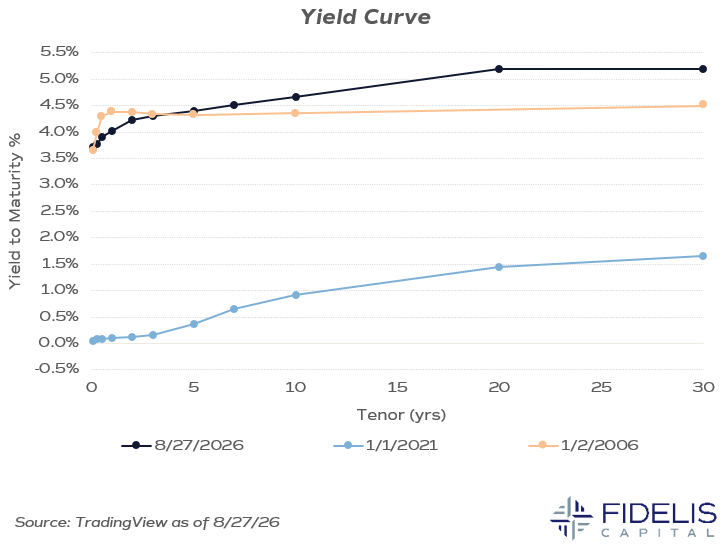
In the chart above, you can see the current yield curve in navy, the yield curve in January of 2021 in light blue, and the yield curve in January of 2006 in orange.
Clearly, you can see the impact of the significant quantitative easing policies of the Federal Reserve after the Global Financial Crisis in the light blue line. It also adjusts for the massive fiscal stimulus that came as a response to the Covid-19 pandemic.
The gap between the light blue and the navy line, showing the significant increase in interest rates since 2021, is remarkable. However, when we view it against a historical context, it doesn’t seem as daunting.
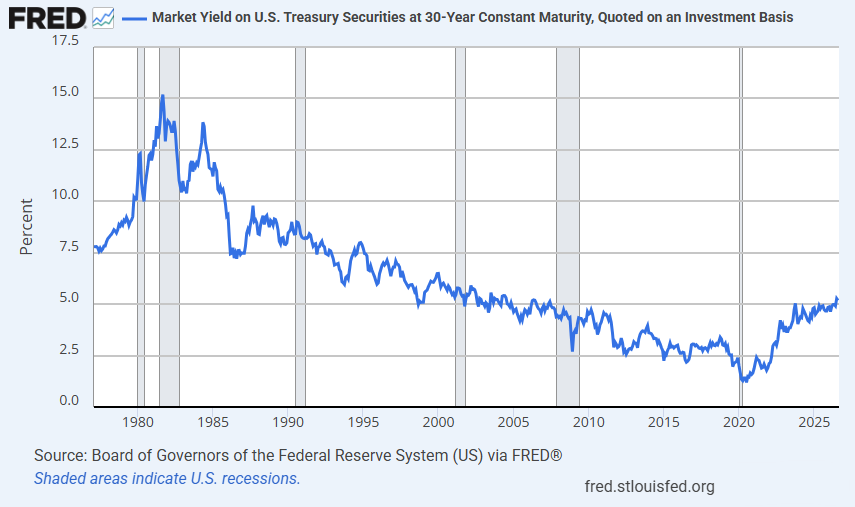
Source: FRED
The above chart measures the daily yield on the 30-year Treasury back to 1977. The average 30-year Treasury yield from 1977 to 2007 was 7.83%. Today, the 30-year Treasury yield is 5.19%.
What to take away from this? Perhaps the period of quantitative easing was the exception and not the rule. A more normal interest rate environment that is not held down by monetary policy decisions can prove more agile at stimulating the economy.
It does, however, lead back to the most important question: Are rates rising because inflation will be higher or growth will be higher? This will be an important concept for Warsh to address in his comments and for the Fed to tackle during the next 12 months.