By: Aaron Wall, CFA
Partner, Portfolio Manager
We hope everyone had a great long weekend celebrating the 250th anniversary of the United States’ independence. This week, markets were relatively range-bound, though there were updates to both components of the Federal Reserve’s dual mandate, employment and inflation.
Employment: The Wage-Price Spiral
On the labor front, jobless claims for the week through July 4 came in at 215,000, slightly less than forecasted. We continue to see data that shows the labor market is on steady footing, indicating that we’re in a labor market with lower hiring but also lower firing.From a Fed perspective, this type of environment is important. A key focus during the inflation spike of 2022 was the wage-price spiral.
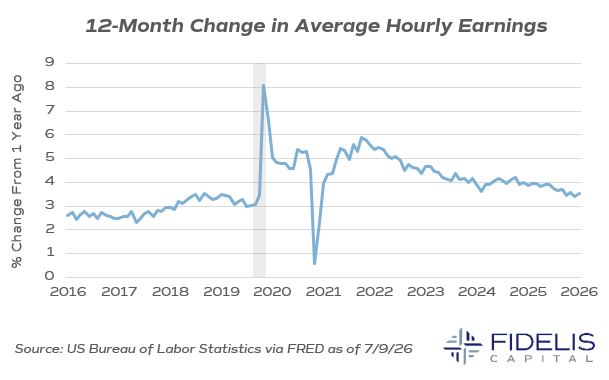
This is a self-fulfilling feedback loop where prices rise across the general economy and workers begin to demand higher wages. These higher wages then lead to increased costs for firms, driving prices up further. This is apparent in the Federal Reserve Bank of St. Louis chart below measuring the 12-month change in average hourly earnings over the last 10 years.
Source: The Federal Reserve Bank of St. Louis (FRED)
We see signs of the wage-price spiral in 2020, a labor environment where firms were hoarding talent. Looking at the last few years, we see a stabilization between 3-4%. Stable is good—we want the long-term inflation trend to ease.
It’s also notable that the current range is a bit higher than the 2010s, when this figure consistently hovered around 2%.
In short, the labor market continues to look steady, an observation that is likely to keep the Fed in a holding pattern for the foreseeable future.
Inflation: Oil Prices Fluctuate After Break In Iran War Ceasefire
On the inflation front, oil prices led headlines this week after the latest event in the Iran war.Iran launched missiles at two commercial ships on Tuesday, leading the US to respond with attacks of its own, underscoring the fragility of the current ceasefire agreement. We are close to the halfway point of the original 60-day ceasefire, and negotiations are expected to resume next week.
It is hard to imagine a clean end to the conflict, namely a re-opened Strait of Hormuz, in the short term. At the same time, markets reacted to this news with a mild selloff in equities and a mild rally in oil prices. Crude oil (WTI) is already working lower, and equity markets have largely recovered from the mild selloff.
The market continues to signal its broader acceptance of the war most likely not ending in a clean resolution anytime soon, and against all odds, it seems to be comfortable with the gyrations of the negotiation process. Before this week, oil was actually near pre-war levels.
We’ll see if this flare up becomes something more significant, but the early response this week doesn’t seem to signal a breaking of the trend just yet.