By: Aaron Wall, CFA
Partner, Portfolio Manager
Happy Friday everyone! We wanted to take a moment to remember all of those who lost their lives, who bravely provided rescue services, and whose families were forever changed 25 years ago. Today, we are keeping these families and first responders in our thoughts as we remember 9/11.
Looking to the markets, all eyes were on this morning’s August CPI report, the last major economic data point in advance of next Wednesday’s Fed meeting.
September Fed Meeting: Hike Or Hold?
This morning, the Bureau of Labor Statistics reported August year-over-year CPI at 3.4%, perfectly in line with market expectations. When we drill down to Core CPI (CPI excluding food and energy), the number was slightly hotter than expectations, coming in at a 0.3% month-over-month against the expectation of 0.2%.Core CPI remains the more important long-term metric because it better reflects the “stickier” components of inflation. As we’ve discussed before, the Fed’s main concern is whether the higher energy prices right now will become embedded, causing price increases in the general economy where energy is a key input.
The highest-weighted component of CPI is shelter, which increased to 0.3% in August from 0.1% in July, no doubt having a meaningful impact on this higher Core CPI reading.
It is worth highlighting that this report covers August, and September has brought renewed escalation in the war, moving fuel prices in the wrong direction so far this month.
All in all, the report lacked major fireworks, but it did move the odds for a rate hike at next week’s Fed meeting higher.
As of Friday at 8:45am ET, there is now an 86.7% probability that the Fed will raise rates by 0.25% next week (the CPI report published at 8:30am ET). Yesterday, the odds of a hike were 72.4%, and one month ago, those odds were closer to a 50/50 split, according to the CME Group’s FedWatch.
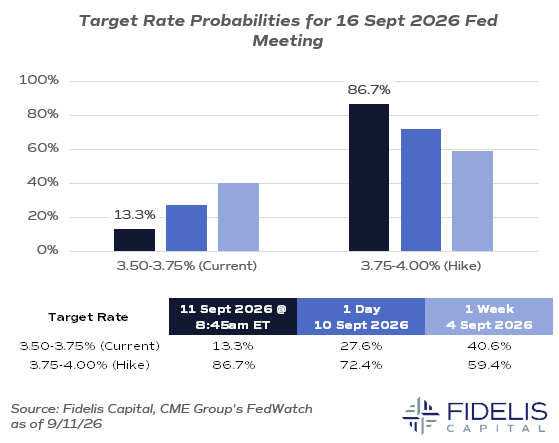
Assuming these expectations hold until the meeting next week, the market is clearly issuing a credibility test to the Warsh Fed. A strong labor market report paired with inflation moving in the wrong direction provides ample justification for a change in interest rates.
As the war continues with no meaningful offramp in sight, the argument for the Fed to hold tight under the assumption that the war will conclude and energy prices will move lower is becoming weaker.
It will no doubt be an eventful few days for monetary policy, and we’ll look forward to unpacking it all next week.
How Did We Get Here?
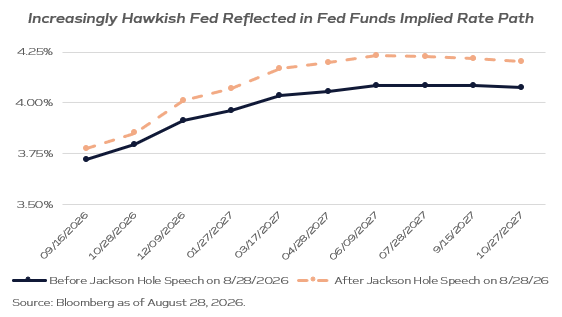
While there was a slight chance the Fed would hike rates at its July meeting, fed funds futures ultimately saw its roughly 70% probability of no change realized.Since then, key economic reports have made a compelling case for the data-dependent Fed to raise rates. This came to a head at the Jackson Hole Economic Symposium on August 28 during Fed Chair Kevin Warsh’s speech, when he came across more hawkish than the market expected.
Catch up on recent key themes in our August Monthly Market Recap, linked here.