By: Michael Sellers
Partner, Portfolio Manager
The stock market has delivered strong gains year-to-date despite ongoing concerns about the Iranian conflict, elevated oil prices, inflation concerns, and continued geopolitical uncertainty. The S&P 500 is up over 9% YTD, and the Dow and the Nasdaq are up over 5% and 14%, respectively. This begs the question…
What’s Driving Stock Market Returns This Year?
One driver is strong earnings. As we discussed in the May 8 edition of Insights, earnings have exceeded expectations so far this year. Results from “Mag 7” companies have received considerable attention and with good reason—those companies have benefited from the increasing capex spend toward all things AI.According to FactSet, the “Mag 7” reported an astonishing 63.2% year-over-year earnings growth in the first quarter. The earnings strength has not been limited to the “Mag 7”, however.
The “Other 493” of the S&P 500 reported an earnings growth rate of 17.4%, which would have been the highest earnings growth rate since Q4 of 2021. That is an important distinction, as it suggests this rally has broadened beyond a narrow group of AI-related companies and reflects an improving earnings backdrop across a larger portion of the market.
Just as importantly, earnings expectations for the rest of 2026 remain constructive. Current consensus estimates call for year-over-year earnings growth above 20% in each of the next three quarters, suggesting analysts continue to expect a healthy corporate profit environment.
Another driver is that the broader economy remains resilient. First-quarter GDP came in at 1.6%, driven by a surge in business investment. Second-quarter GDP is tracking at 3.8%, according to the Federal Reserve Bank of Atlanta.
Underpinning this economic resilience has been a strong labor market. Despite ongoing concerns surrounding AI-led employment disruptions and slowing global growth, the unemployment rate currently sits at 4.3%, which remains historically low.
Furthermore, the four-week moving average of weekly initial unemployment claims, a real-time indicator of labor market health, has improved in recent weeks. As illustrated in the accompanying chart, the four-week average of jobless claims has been trending lower, suggesting the labor market continues to stabilize.
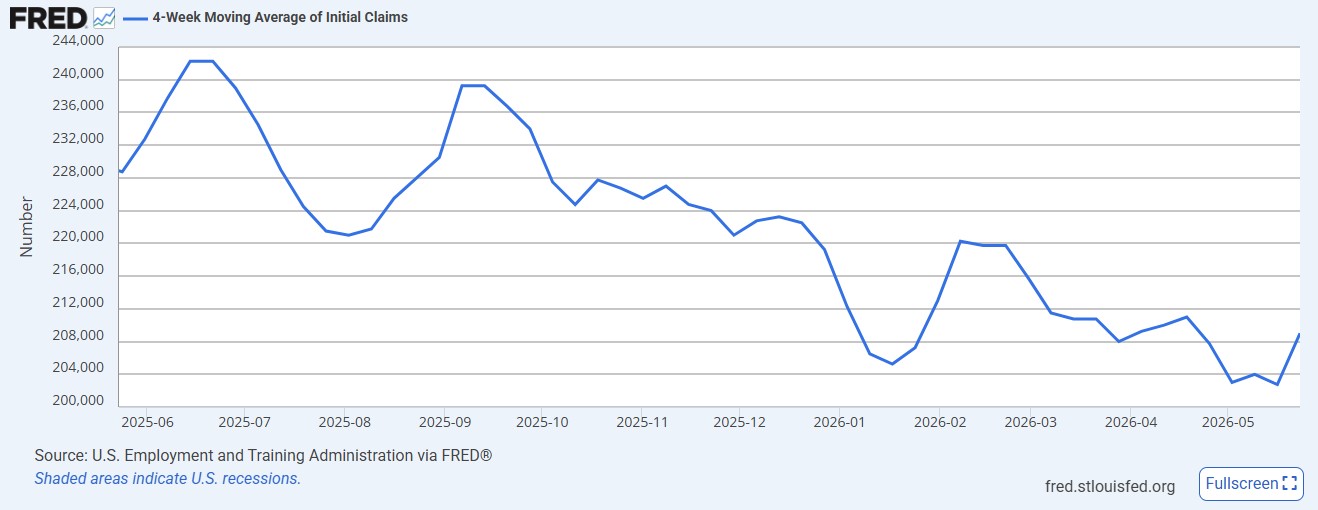
Source: FRED
Traditionally, a stronger labor market also supports stronger consumer spending. According to data released by the Bank of America Institute, consumer spending accelerated strongly in April, with credit card and debit spending rising 4.8% year-over year, its strongest monthly growth in three years. Even excluding gasoline prices, spending rose at a healthy 4.0% year-over-year.
What Does This Mean For The Rest Of 2026?
Markets have been remarkably resilient in the face of geopolitical uncertainty, elevated oil prices, and inflationary risks. However, there is likely a natural ceiling on risk asset valuations if the Iranian conflict continues to escalate or begins to materially impact global energy markets and inflation expectations.We are also aware that mid-term election years can be notoriously volatile, especially as we move towards the summer trading season.
At the same time, strength in both corporate earnings and the labor market remain important when assessing future expectations of the economy and financial markets. According to Strategas Research, we’ve never had a recession when (1) corporate profit growth is positive year-over-year, and (2) without seeing a rise in the unemployment rate.
There’s the old Wall Street warning that “the economy is not the market.” However, a stronger economic backdrop—profits and labor included—typically leads to a more confident and durable market sentiment.
Ultimately, the path forward for markets will likely depend on whether earnings momentum continues, whether a de-escalation in the Iranian conflict helps soften inflationary pressures, and whether the labor market can continue to support a resilient US consumer.
For now, investors appear willing to look through geopolitical uncertainty and focus on what has mattered most thus far this year: strong earnings, solid economic growth, and a labor market that continues to hold up better than many expected.