By: Michael Sellers
Partner, Portfolio Manager
Happy Friday everyone! Global markets were focused on the Federal Reserve’s September meeting this week—let’s dive into the details.
The Fed Raised Rates. Now What?
At the conclusion of Wednesday's FOMC meeting, the Fed voted unanimously to raise its benchmark interest rate by 25 basis points to a target range of 3.75% to 4%. It was the Fed’s first rate hike since July of 2023.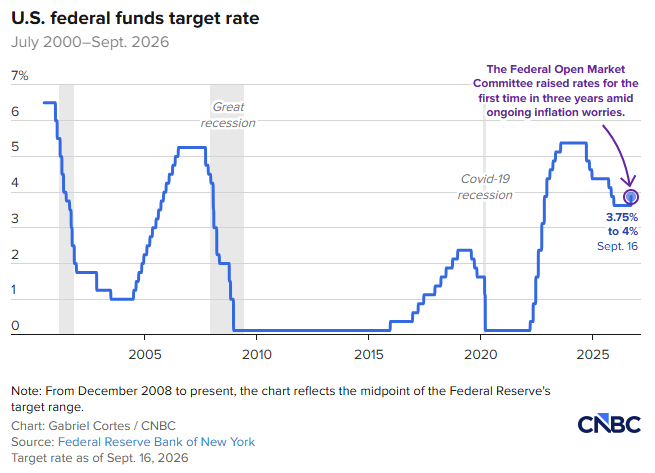
Source: CNBC
The move was widely anticipated, with the Fed Funds Futures markets showing more than a 90% chance of a hike ahead of the meeting. This represents a dramatic shift in investor sentiment as only one month ago, the probability of a September hike was just 36%.
The Fed’s decision, and the recent change in market expectations, comes at a time when both interest rates and inflation expectations continue to rise.
The benchmark 10-year Treasury has been bouncing around 5% and earlier this week hit a yield of 5.041%, while the 30-year Treasury yield hit 5.401%, their highest levels respectively since 2007.
Fed Chair Kevin Warsh specifically noted the impact of continued macroeconomic uncertainty caused by the Iran war and its strain on energy markets. In the post-meeting press conference, Warsh stated, “…there’s no hiding from hot spots around the world...”
Oil continues to fluctuate around $100 a barrel as tensions with Iran remain elevated.
Where Do Rates Go From Here?
In addition to a unanimous vote to raise rates, 16 of 18 Fed officials who submitted dot-plot projections indicated they see at least one more rate hike this year, representing a more hawkish sentiment growing within the Fed.Looking beyond 2026, the dot-plot submissions project no additional hikes in 2027, and one cut each in 2028 and 2029.
Fed Chair Warsh did not submit a projection for the path of future rate moves, which he proactively addressed leading into to the meeting.
What Happens To Stocks After The Fed Raises Rates?
According to research from Strategas, an initial rate increase has historically not served as a significant downward catalyst for stocks. Instead, markets have generally taken the first move in stride, as it often reflects an economy that remains on solid footing.Looking back at the eight previous "first hikes" of a cycle since 1983, the S&P 500 has delivered positive returns, on average, following the initial increase in interest rates. Three months after the first hike, the index has gained an average of 1.2%, and six months later, it has been higher by an average of 5.7%.
What Did We Learn About The Fed?
First, the Fed – including Chair Kevin Warsh – has demonstrated it is serious about bringing inflation down from its current levels. The unanimous nature of the vote underscores the perspective shift occurring within the Fed, as officials increasingly recognize the potential risks posed by persistently higher inflation. This marks a notable change from the Fed’s last meeting in July, when officials voted 9-3 to leave rates unchanged.Second, the unanimous vote helped the Fed, and more importantly new Fed Chair Warsh, establish credibility despite ongoing external political pressure for lower interest rates.
Third, we know the Fed may not be done. As mentioned, the dot-plot projections indicate Fed officials see at least one more rate hike in 2026. The Fed meets next at the end of October and then again in early December to close out the year.
Final Thoughts
We were encouraged to see the Federal Reserve's views evolve in response to a rapidly changing geopolitical and macroeconomic environment.Warsh demonstrated that he takes the threat of inflation seriously and is prepared to act in a manner consistent with the Fed's dual mandate of price stability and maximum employment, regardless of external pressures. That’s a good sign.
The Fed’s perspective shift from July to September also underscores its approach of being flexible and responsive to changing economic conditions and market data. We also view this as a positive development.
The Fed's next meeting is scheduled for October 27-28, approximately six weeks from today.
More recently, there was a material shift in the Fed’s perspective during the six weeks between its July and September meetings. We will continue to monitor the ever-changing shifts in macroeconomic data and the geopolitical landscape, but we leave this week’s Fed meeting encouraged by the fact that the Fed is being thoughtful and prudent and not following a predetermined path.
Bonus: Where Should Investors Park Cash In A Rising Rate Environment?
With better yields on cash around the corner now that the Fed has hiked rates, where should investors put their dry powder?Head of Fixed Income Chris Gunster spoke with CNBC about why money-market funds and municipal bonds are the place to be. Read the story here.